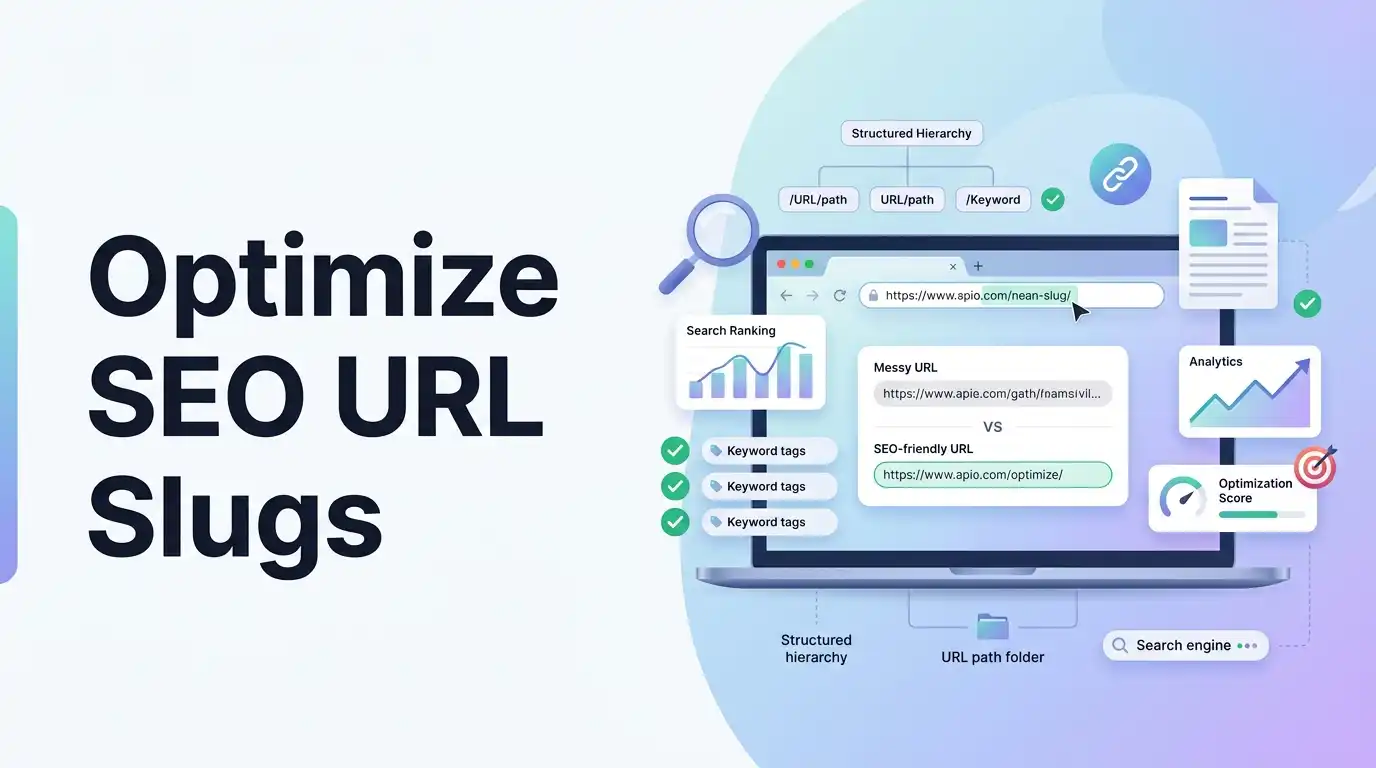
When building a website or writing a blog post, the structure of your link address plays a crucial role in search engine visibility. Even if your page content is high-quality, a confusing or messy URL structure can hurt your rankings and make users hesitant to click your links.
Optimizing the final segment of your web address—commonly known as the page slug—is one of the simplest yet most effective SEO practices.
A clean, hyphenated slug communicates the topic of your page immediately to both search engine crawlers and human visitors.
In this guide, we will break down what a web address slug is, examine how search engines parse links, and review step-by-step best practices to optimize your URLs.
[!TIP] Struggling to clean up page titles or filter out prepositions? Skip the manual sanitization and generate clean address paths using our free, interactive URL Slug Generator to instantly format links and preview Google search snippets!
What is a URL Slug?
A URL slug is the user-readable portion at the end of a web address that points to a specific page. It is named after the layout terminology used in journalism, where editors use short, descriptive text keys to identify news stories during print production.
- Example URL:
https://creatorsfeel.com/tools/url-slug-generator - The Slug:
url-slug-generator
The slug is designed to be easily readable by humans, replacing database queries or auto-incremented parameter strings (like ?p=8923) with clear, descriptive words.
Why URL Slugs Matter for Search Indexing
Search engine recommendation systems analyze several areas of a webpage to determine its topic relevance, and the URL structure is one of the first areas examined.
- Keyword Signals: Placing a target search phrase in your slug helps search engines verify that your page is relevant to queries about that term.
- Search Snippet CTR: When search results are displayed, the URL is shown at the top of the card. A clean, descriptive slug reassures searchers that the link is safe and matches their intent.
- Link Trustworthiness: Messy URLs containing numbers, symbols, and parameters look like spam. Clean slugs get shared more frequently on forums, email, and social networks.
The Step-by-Step Slug Sanitization Process
To understand how text is converted into an SEO-friendly slug, let’s walk through an example.
The Page Title:
“10 Easy Tips to Improve SEO in 2026!”
Step 1: Normalization and Lowercasing
Convert all letters to lowercase. Capital letters can cause server routing issues on some operating systems.
"10 easy tips to improve seo in 2026!"
Step 2: Remove Special Characters
Strip out punctuation, exclamation marks, question marks, parentheses, and brackets.
"10 easy tips to improve seo in 2026"
Step 3: Remove Conjunctions and Prepositions (Stop Words)
Filter out common filler words (to, in, and, the) to keep the slug short and focused on high-value keywords.
"10 easy tips improve seo 2026"
Step 4: Hyphen Joining
Replace spaces with hyphens. Avoid using underscores, as search engine crawlers do not treat underscores as word boundaries.
"10-easy-tips-improve-seo-2026"
By using an automated url slug generator or seo slug generator, this entire process happens instantly in your browser as you type.
5 Best Practices for Optimizing URL Slugs
Follow these simple rules whenever you create a new page or write an article:
1. Keep It Short and Direct
Aim for 3 to 5 words or under 60 characters. Short URLs are easier to remember, copy, and paste, and they do not get truncated in search listings.
2. Always Use Hyphens as Separators
Google’s indexing guidelines explicitly state that hyphens are treated as word separators, while underscores are treated as word connectors. Use hyphens to help crawlers read your keywords.
3. Avoid Future-Dating Slugs
If your title has a year (like “2026”) or a number (like “10 tips”), consider omitting them from the slug. This allows you to update the article in the future without changing the URL and needing to set up redirects.
4. Focus on the Primary Target Keyword
Do not try to fit all keywords in the slug. Select the single most important keyword phrase that represents the page topic and use that.
5. Strip Accented Characters
Ensure the slug only contains standard alphanumeric characters (a-z, 0-9). Accented characters (like é, ö, or ç) can translate into complex percent-encoded strings (like %C3%A9) when pasted, making links look messy.